

Remembering My Dad
What we inherit, what we become


"The world breaks everyone, and afterward many are strong at the broken places." ~ Ernest Hemingway
Last Father’s Day, I wrote this piece about my dad.
Rereading it a year later, I recognize a deeper thread that has been running through my life, shaped in no small part by him: a desire to be of service, to live a meaningful life, and to belong to something larger than oneself.
My dad was a veteran of three wars: World War II, the Korean War, and Vietnam. His life was defined by service, something I deeply admired about him.
When he returned from deployments, we would pick him up in Norfolk. One year, we even had the chance to go aboard the aircraft carrier USS Forrestal. I was maybe nine or ten years old. I remember feeling a swell of pride, seeing him as part of something vast and essential, supporting an entire world I didn’t yet understand.
Little did I know that years later I would find myself working in Naval Aviation.
And while that work was meaningful, I eventually left to dedicate myself to a different kind of service, one rooted in healing, presence, and the belief that inner life matters as much as outer achievement.
The essay below is what I wrote last year, closer to the surface of that story, as I was still making sense of what it all meant.
My relationship with my dad has always been complicated.
One of my first comforting memories of him was when I was about six years old. I had strep throat, and my mom couldn’t leave work, so he took me to the doctor at Bethesda Naval Hospital — what’s now Walter Reed. I remember walking through the hospital, my small hand tucked inside his. I felt safe. After the appointment, he took me to the cafeteria for a hamburger. That may have been my favorite part.
I remember him coming home from work, often before my mom, sometimes starting dinner. He wasn’t a great cook, but he tried. There was a dish we called “hot dog surprise,” which usually involved whatever leftovers were in the fridge… plus hot dogs. And his infamous apple pie that looked beautiful, but the crust was so hard you needed a steak knife to get through it.
Stuckey’s and Sweet Corn
When I was young, there were long stretches when my dad wasn’t around. He was active duty in the Navy and would be deployed for months at a time. My mom, working full-time, somehow managed it all. When his deployments ended, she’d pack us into our wood-paneled Vista Cruiser and drive the four hours south to Norfolk, Virginia, to pick him up. We’d stop at Stuckey’s for pecan pie and buy sweet corn from roadside farm stands.
Those first days back were always a little tense. The smell of coffee and cigarettes, the creak of my dad’s ankles on the stairs: telltale signs that the house had changed, and that we kids couldn’t run wild like we did when he was gone. But there were also small pleasures. In the summer, I’d find him outside mowing the lawn. He’d come back in, sweaty and tired, and make one of my favorite meals: fried eggs over rice, the yolk runny, seasoned with salt and pepper.
And then there was his other side.
The Birthday Cake
“Happy Birthday!” he exclaimed one year, stepping into the house with the most spectacular cake I had ever seen. A gingerbread house stood proudly on top. He smelled of Old Spice, cigarettes, and something sharper — alcohol laced with celebration. I was thirteen. My mom was in the Philippines visiting family. I was so happy that for once, I was being celebrated.
Until I noticed the strange woman behind him.
Before I could fully register what was happening, they were already leaving. “Have fun — Happy Birthday!” he called out cheerfully, while she followed him, laughing nervously.
I stood there alone, staring at the cake. A heavy sadness washed over me as I realized he wasn’t coming back.
For years, that memory shaped how I saw him: a charming, erratic man whose love was unpredictable and whose presence was painful. He had a violent temper when he drank, and he drank a lot. I learned early how to stay small. I learned how to read the room for danger. And I carried those lessons into adulthood, choosing partners who mirrored that same volatility — fun-loving, charismatic, intoxicating, sometimes cruel.
But later, after I married and my husband joined the Air Force, my relationship with my dad began to shift.
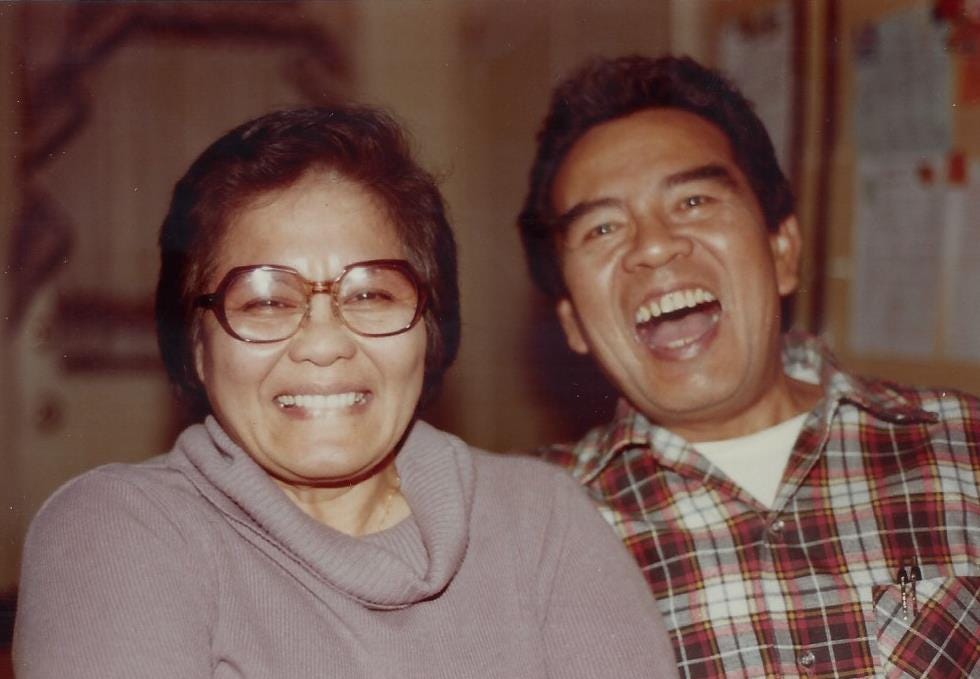
Maps and a Road Trip
My parents helped me drive across the country to Monterey, California, where my husband was training at the Presidio’s language school. My dad meticulously planned the route, ordering AAA maps and marking all the stops. We drove for days — long stretches of endless highways, overnight stays at Best Western motels, through the Great Salt Flats of Utah, where the sky met the earth in a shimmering white haze; through Reno, where we played the slots, laughing like we had nothing to lose; through the desert Southwest, headlights cutting through the inky night. I remember dusty farm roads in rural California, stained fingers from eating sweet cherries we bought from a roadside stand.
We shared long, quiet hours, simple motel breakfasts, and road-trip conversations. Somewhere along the way, I learned more about my dad’s childhood — that he grew up dirt poor, that he didn’t own a proper pair of shoes until he joined the Navy during World War II. That he too had suffered abuse. It didn’t excuse anything, but it helped me understand the weight he carried.
For the first time, I began to see my parents not just as the figures of my childhood, but as complex, flawed, human beings — trying their best, full of contradictions and capable of surprising humor, and tenderness.
The following year, before leaving to meet my husband in Korea, I worked a summer job at the same Army agency my dad had served since retiring from the Navy. Our offices were just down the hall from one another. Every morning, he drove us through rush hour traffic, both ways, navigating the stop-and-go with practiced patience. There was never any question that he’d take on that chore. He saw it as his duty, and there was something quietly chivalrous about it, as if he was making up for the times he hadn’t been there. While he drove, I sat beside him finishing my makeup. He knew I wasn’t a morning person and never rushed me.
My mom packed lunches for both of us, and my dad stored mine in his office refrigerator. At noon, he’d walk it down the hallway and deliver it to me with a simple, familiar nod. It was such a small gesture, but it landed deeply — an offering without fanfare. In those weeks, I saw him differently. I witnessed his competence, his quiet rituals, and the way his colleagues respected him. And I had a new respect for him too, not with blind forgiveness, but with the clarity that comes from seeing someone more fully.
Those moments didn’t erase the pain of my childhood. They didn’t undo the fear, the confusion, or the longing. But they softened the edges. They let more truth in.
Making Room for the Whole Story
My father was never just one thing. He was a man of contradictions: tender and terrifying, loving and unreliable. And through the lens of time, I’ve learned to hold all of it.
Six months after he finally retired from the Army — after more than thirty years in the Navy and nearly two decades of Army civil service — my dad had a stroke. He had plans for retirement: to travel with my mom, to learn how to play golf, to enjoy the life he had worked so long and hard for. Those fifteen years leading up to his stroke were probably the happiest my parents were as a married couple. He had mellowed, and their life had grown more peaceful. When his health declined, my mom retired early to care for him, and she remained his caregiver for the next fourteen years until he passed in 2008. That chapter with its quiet grief and my mom’s daily sacrifices is a story I have yet to fully tell.
Father’s Day can be complicated. For some of us, it’s not a Hallmark holiday. It’s a day that stirs grief, gratitude, and memory in equal measure. But today, I’m honoring the whole picture. The man who made hard-crusted pies and runny-yolk eggs. The man who drove me cross-country and delivered my lunch down the hall. The man who hurt me, and who, in his own imperfect way, also loved me.
And maybe that’s what healing really asks of us: Not to forget the harm, but to make room for the whole story.
To tolerate ambivalence.
To live with the ache and the grace.
The wholeness of a life, imperfect and real.
A year later, I still find myself returning to these memories. What has changed is not the story itself, but my capacity to hold it with greater ease, and a deeper understanding of how much of who I am was shaped in its wake.
If you enjoyed this reflection and my other content, please show your support with a❤️, comment, restack, and/or recommend to spread the word. And consider subscribing, free or paid. It helps me keep writing pieces that invite presence and meaning.
Additional Resources:
I’m excited to be offering a recurring 10-Week Mindfulness for Stress Management series through The Mindfulness Center. Sessions are recorded so you can join anytime. The Summer session starts Tuesday, June 23rd-August 25th, 2026. Experience evidence-based practices to reduce stress, build resilience, and reconnect with a sense of calm and clarity. Perfect for beginners and seasoned practitioners alike. Learn more and register here.
For a deeper dive, consider one-on-one sessions. Founding Members get exclusive discounts on sessions. Check out my offerings here.